
A 2025 published study examined whether and how Red Pandas could be photographed in the wild using camera traps.
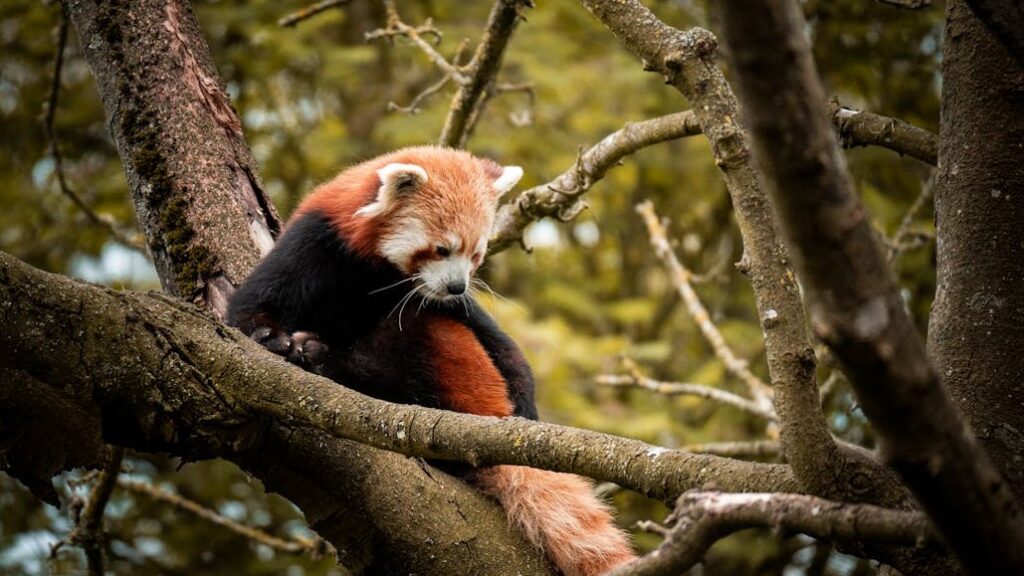
This is important because studies of Red Panda behavior were previously only possible through direct observation, analysis of feces, and GPS collar deployment.
Camera traps are a comparatively new method, and knowledge about where to install the cameras to obtain usable images of Red Pandas has been lacking.
The study by Sonam T. Lama (Red Panda Network) and Kathryn A. Bugler, James G. Ross, and Adrian M. Paterson of Lincoln University (New Zealand) sought to answer these questions.
60,000 Photos
The researchers installed camera traps in the Kangchenjunga landscape in eastern Nepal, home to the largest local Red Panda population. A total of 19 camera pairs were placed in the forests — every pair with one camera near the ground and one camera in the tree canopy at approximately five meters.
Ultimately, only eleven of the nineteen camera pairs produced photos. Almost 60,000 images were counted. However, of these, only 1.5%, or 903 photos, showed Red Pandas. The rest of the images were false triggers or showed other species.
Recommendations
The researchers counted a total of 59 independent encounters with Red Pandas. Twenty-one of these encounters took place at ground level, and 38 took place in the tree canopy. Arboreal camera traps captured eight times more images of the animals’ activities than ground-level traps.
“For example, during a 2-hour, 18-minute event, an arboreal camera recorded a red panda engaged in various activities, including sleeping in different postures, grooming, and exploring their surroundings and the camera.”
Lama, S. T., K. A. Bugler, J. G. Ross, and A. M. Paterson. 2025: “Use of Camera Traps to Record Wild Red Panda Activity in Eastern Nepal.” Wildlife Society Bulletin 49: e1583.
Additionally, the images from the trees were clear enough to distinguish the facial markings of each individual panda. Although mounting the cameras in trees is more labor-intensive, researchers recommend placing camera traps in tree canopies around 5 meters high.
By the way, the Red Pandas were most active—or most camera-suitable—between 4:00 a.m. and 6:00 a.m.
Read more
Lama, S. T., K. A. Bugler, J. G. Ross, and A. M. Paterson. 2025: “Use of Camera Traps to Record Wild Red Panda Activity in Eastern Nepal.” Wildlife Society Bulletin 49: e1583. https://doi.org/10.1002/wsb.1583 License: CC BY 4.0. https://creativecommons.org/licenses/by/4.0/.